
Protect your privacy
How can I protect my privacy online?
There are ways to protect yourself against tech companies' hunger for data. Staying completely anonymous online is difficult, but here are four tips to help you protect your privacy as much as possible.
1. Use a VPN
There are companies, known as data brokers, that specialize in collecting and selling your personal data. A VPN encrypts personal data so that data brokers cannot simply intercept it. A VPN can also mask your real IP address, making it more difficult to link online activities directly to you. Choose a VPN that supports the OpenVPN protocol.
2. Use secure browsers and search engines
Mozilla Firefox is a privacy-friendly option for safe internet browsing. Unlike popular browsers such as Microsoft Edge and Google Chrome, Firefox offers unique advantages for users who value privacy and control. In addition, Firefox is completely open source (the source code of the software is publicly available).
A good alternative to Google for your searches is DuckDuckGo. This search engine does not collect personal data and does not track your search history.
3. Switch to secure digital communication platforms
Consider using Signal instead of WhatsApp. Signal offers strong encryption and collects minimal personal data, which benefits your privacy.
ProtonMail is a good choice for email. ProtonMail offers end-to-end encryption, which protects your privacy better than Gmail.
Also, be careful with dating apps. Messages on dating apps are not encrypted. An alternative is to switch to Signal. There, you can safely flirt with each other without exchanging numbers!
4. Avoid using plugins such as Adobe Reader, Apple QuickTime, HP Print Services, etc.
Avoid using plugins such as Adobe Reader, Apple QuickTime, and HP Print Services to protect your privacy. These plugins may contain vulnerabilities and unintentionally share personal data with third parties. Instead, use built-in features of your operating system for tasks such as PDF reading and media playback. This minimizes the risk of data leaks and increases your control over your personal information, contributing to a safer online experience.
There are several measures you can take yourself to protect your privacy. However, it is crucial to collectively put a stop to current data collection practices. Companies currently collect far too much information without the explicit consent of users. The only way to effectively address this is by acting together.




How do I request my data
and how do I delete it?
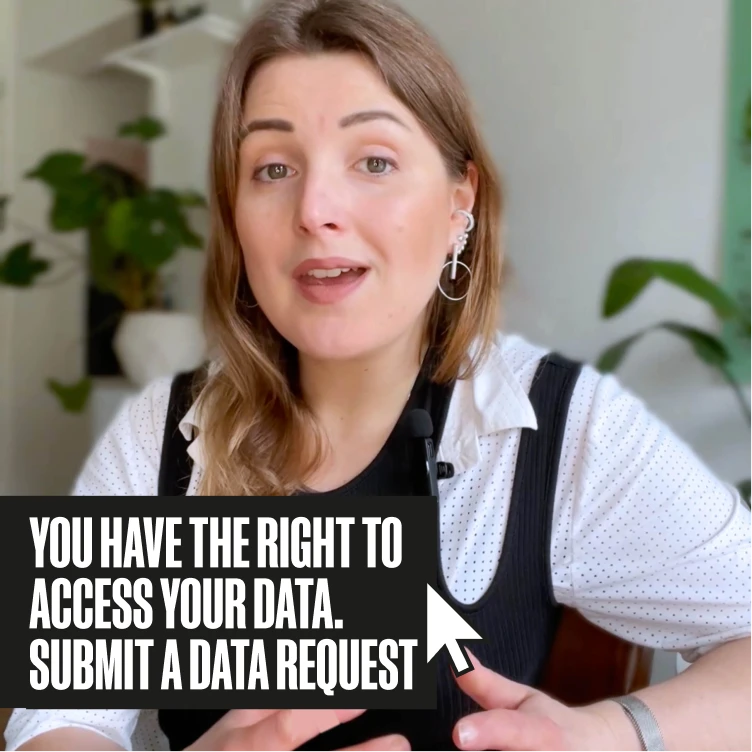
According to the GDPR, the European privacy legislation, a company that processes personal data must have a person or department responsible for processing that data. From your email address to tracking your clicks and mouse movements: if they store it, you have the right to request it. You can do this with a data request. Companies often do not clearly explain how you can submit a request yourself because they do not want you to know what they know about you. But in most cases, this is easy to do in one of the following two ways.
Sending an email
The most common way to submit a data request is by sending an email. The address for this is listed in the privacy policy of the company from which you wish to request your data. Let's take Amazon as an example:
Step 1: Find the contact details of the data controller in the privacy policy, such as [email protected].
Step 2: Then compose an email describing what you want to know and refer to Article 15 of the GDPR (right of access). You can also use the sample letter provided by the Dutch Data Protection Authority.
Step 3: You should receive a response within 30 days, in accordance with the legal deadline. If the company is well organized, this may happen sooner, but if you do not receive a response, you must take action. Failure to respond to a data request is against the law. You can file a complaint about this with the Dutch Data Protection Authority.
Automatic data request
Large companies often offer an automatic option to submit a request for your data. Here is a guide to requesting your data from Google. What is the most remarkable thing Google knows about you?
Step 1: Go to your Google Dashboard.
Step 2: Click on ‘Download your data’ and choose which data you want to receive from Google products such as Maps, Search, or YouTube.
Step 3: Check your email. An automated data request is usually quick; within a few minutes to a few hours, you will receive a comprehensive data package in your mailbox.
The easiest way to find this on other platforms is to search for ‘Company + data request / data access request’. For example: Facebook data access request

How does the advertising industry work?
The advertising industry (ad tech) revolves around showing personalized ads to users. Companies collect data about your internet behavior and use it to create accurate profiles. They use these profiles to target you as precisely as possible.
Here's how it works:
Imagine that the ad tech industry is a large and busy shopping mall. In this mall, there are various stores (the advertisers) that are desperate to sell their products and services. They want as many people as possible, especially the right people, to see and buy their products. They are willing to pay for a good spot to hang their advertisements (posters, flyers, etc.), but they want to be absolutely sure that these spots are good and that they reach their target audience.
On the other side of the shopping center are the owners of the retail spaces (the publishers). These are the people who own the physical spaces in the shopping center, such as walls and screens where advertisements can be displayed. They want to earn as much money as possible by renting these spaces to advertisers.
The Ad Exchange
In the middle of the shopping center is a large digital bulletin board (the ad exchange). This bulletin board functions as a marketplace where advertisers and publishers come together to negotiate where and when ads will be displayed. This bulletin board is smart; it holds an auction where advertisers bid to get their ads in the best spots.
The Tools
To keep this machine running smoothly, advertisers and publishers use various sophisticated tools:
- Demand-Side Platforms (DSPs): These platforms help advertisers buy ads automatically. It's like having an obsessive personal assistant who knows exactly where and when to put up your posters to reach the most people.
- Supply-Side Platforms (SSPs): These platforms help publishers sell their advertising space. It's like having a savvy manager who rents the space to the highest bidder and makes sure it's always fully booked, regardless of the impact on visitors' privacy.
- Data Management Platforms (DMPs): These are the shadowy analysts who collect data about visitors to the shopping mall. They keep track of everything: which stores people visit, what they like, and when they usually come. This information is used to help advertisers hang their posters in the most manipulative places.
Why is data necessary?
To ensure that the right advertisements reach the right people, advertisers and their invisible tools require an abundance of data. This data includes information such as:
- Which stores you visit (which websites you view)
- What you like (your interests and online behavior)
- How often and when you visit the shopping center (your browsing behavior and time of day)
By collecting and analyzing all this data, advertisers can spy on you and accurately determine who should see their ads and when. This makes their ads much more effective and increases the likelihood that you will buy something, at the expense of your privacy.
How Does This Violate Your Privacy?
To collect all this data, ad tech companies track your online behavior very closely. This can harm your privacy in several disturbing ways:
- Tracking Cookies: Small files that are secretly stored on your computer and track your online activities without your knowledge.
- Profiling: Building a detailed profile of you based on your online behavior, which means companies know much more about you than you would like to share.
- Data Sharing: Data is often shared between different companies without your explicit consent, which can lead to even more unwanted tracking and profiling.
- Targeted Ads: Ads that are specifically targeted at you can sometimes feel eerily personal, as if companies know exactly what you are doing and what your interests are.
The result is that while you are trying to enjoy the shopping center, an invisible layer of intensive data collection and tracking is taking place. This layer ensures that you are constantly being spied on and manipulated so that you see advertisements specifically targeted at you, but it does so at the expense of your privacy and autonomy. This industry exploits people by using their personal information without their full knowledge or consent.


Report abuses:
Are you receiving unwanted cookies? Have you requested your data but not received anything? Have you been affected by a data breach?
Let us know by filling in the form.